
Crypto trading has moved well beyond basic spot buying and selling. Active traders increasingly look for perpetual futures, automated strategies, flexible margin systems, demo trading, and access to multiple markets from a single platform.
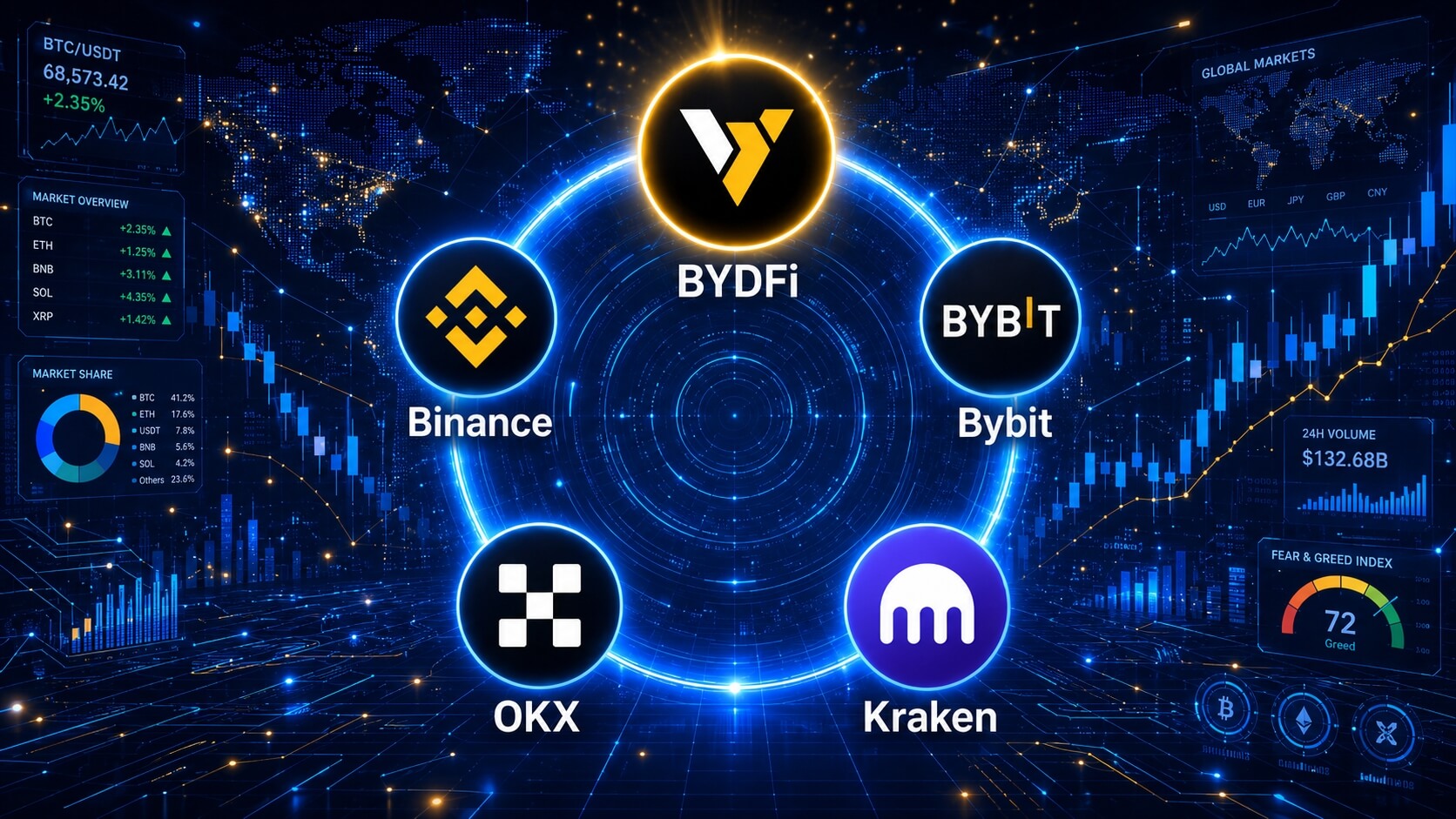
However, many exchange rankings still focus primarily on beginner-friendly interfaces and basic spot trading. This guide compares six crypto exchanges based on the features that matter more to active and strategy-driven traders, including derivatives, automation, cross-market access, risk-management tools, and trading costs.
Table of Contents
- 1. BYDFi — Best Overall for Crypto Futures, Trading Bots, and TradFi
- 2. Binance — Best for Liquidity and Large-Volume Trading
- 3. Bitget — Best for Copy Trading, Trading Bots, and Multi-Asset Exposure
- 4. Bybit — Best for Copy Trading and MT5-Based TradFi
- 5. OKX — Best for Combining Centralized Trading, DeFi, and X-Perps
- 6. Kraken — Best for Stocks, Tokenized Equities, and Compliance-Focused Trading
- Quick Comparison of the Best Crypto Exchanges for Advanced Traders
- Frequently Asked Questions
- Final Verdict
1. BYDFi — Best Overall for Crypto Futures, Trading Bots, and TradFi
What it offers
Founded in 2020, BYDFi has developed into a global crypto trading platform serving more than one million registered users across over 190 countries and regions.
The platform combines spot trading, perpetual futures, built-in trading bots, copy trading, demo trading, and TradFi products within one trading ecosystem.
BYDFi supports three major types of perpetual contracts:
- USDT-M perpetual contracts
- USDC-M perpetual contracts
- COIN-M perpetual contracts
Depending on the contract, traders can select leverage ranging from 1x to 200x. The platform also provides isolated and cross-margin modes, hedge mode, advanced order types, and TradingView-powered charting.
Why it matters
BYDFi earns the top position because of the way it combines several advanced trading functions rather than relying on one standout product.
Its built-in trading bots support automated strategies such as grid and DCA trading. These tools allow users to execute rule-based strategies without manually monitoring every market movement.
BYDFi also provides a demo trading account funded with 50,000 USDT in simulated assets. Traders can use it to test perpetual futures strategies, explore leverage settings, and become familiar with the trading interface before committing real funds.
The platform’s TradFi offering expands this setup beyond crypto. Users can trade stock-related products linked to major US companies, including Apple (AAPL), Amazon (AMZN), Tesla (TSLA), Microsoft (MSFT), AMD, and Coinbase (COIN). BYDFi also provides access to major forex currency pairs through perpetual trading products, as well as commodities such as gold (XAUUSD) and other selected markets.
These TradFi products are settled in USDT and integrated into BYDFi’s futures trading interface, allowing users to trade long or short and use leverage on eligible instruments. They can be accessed around the clock without opening a separate traditional brokerage account. Eligible TradFi pairs are promoted with zero trading fees, although spreads, funding fees, and other market-related costs may still apply.
BYDFi’s standard perpetual futures fees are:
- Maker fee: 0.02%
- Taker fee: 0.06%
Further fee reductions are available through the platform’s VIP program.
Trade-offs
Fiat purchases generally rely on third-party payment providers rather than direct bank transfer services.
BYDFi is also unavailable in certain jurisdictions, including the United Kingdom, Singapore, and Indonesia. Traders should verify regional availability before opening an account.
2. Binance — Best for Liquidity and Large-Volume Trading
What it offers
Binance provides one of the largest crypto derivatives ecosystems, including USDT-M perpetuals, COIN-M perpetuals, quarterly futures, options, margin trading, trading bots, and copy trading.
The platform is particularly well known for its deep order books and broad range of crypto trading products.
Binance has also expanded beyond crypto. Eligible users can access U.S.-listed stocks and ETFs alongside their crypto holdings, although product availability depends on the user’s region.
Why it matters
Binance’s main advantage remains liquidity.
Deep order books can help reduce slippage when traders enter or exit large positions, particularly in heavily traded crypto markets. This makes the platform attractive to high-volume traders and users running strategies that depend on fast execution.
Binance also offers options and quarterly futures, providing additional ways to hedge market exposure or build more complex derivatives positions.
Its move into stocks and ETFs means Binance can no longer be described as a crypto-only platform. However, the availability and structure of these products vary by jurisdiction.
Trade-offs
Binance’s extensive product range can make its interface difficult to navigate, particularly for traders switching between spot, margin, futures, options, bots, and investment products.
Regional differences are another consideration. Users in different countries may have access to significantly different versions of the platform and product catalogue.
Binance offers strong liquidity and a broad financial ecosystem, but its large number of separate products can create a steeper learning curve than a more focused platform.
3. Bitget — Best for Copy Trading, Trading Bots, and Multi-Asset Exposure
What it offers
Bitget is a global crypto trading platform that combines spot trading, futures, copy trading, trading bots, and access to traditional financial markets.
For advanced traders, the platform offers futures trading alongside a broad range of automation tools. Bitget supports futures copy trading, where users can automatically replicate the positions of selected elite traders. Traders can review metrics such as ROI, win rate, trading history, and followers' profits before choosing a strategy to follow.
Bitget also has an extensive trading bot ecosystem covering strategies such as spot and futures grid trading, trend-following, Martingale, and auto-invest products. In 2026, the platform expanded its bot offering to include TradFi selections such as U.S. stocks, ETFs, gold, and crude oil.
The platform has also expanded beyond traditional crypto markets. Depending on region and product availability, Bitget provides access to real U.S. stocks, stock derivatives, commodities, and forex-related products. Its stock perpetuals allow traders to gain price exposure to selected U.S. equities without directly owning the underlying shares.
Why it matters
Bitget stands out for combining several forms of automated and social trading within the same ecosystem.
Its futures copy trading system allows users to follow experienced traders while retaining control over parameters such as allocation, leverage, supported trading pairs, and risk-management settings. Bitget also provides features such as stop-loss controls and equity protection tools for copy trading.
The platform's bot ecosystem is another major advantage. Traders can use pre-built strategies or create automated strategies for different market conditions. Bitget has also introduced Bot Copy Trading, allowing users to follow strategies created by experienced bot strategists rather than configuring every parameter themselves.
For traders interested in markets beyond crypto, Bitget's expansion into TradFi provides additional flexibility. The platform launched CFD copy trading covering forex, commodities, and indices, while its newer products include exposure to U.S. stocks, precious metals, and other traditional assets.
Bitget's standard futures trading fees are 0.02% for makers and 0.06% for takers, while additional discounts may be available through its fee structure and VIP program.
Trade-offs
Bitget's wide product range can make the platform more complex for users who only want straightforward spot or futures trading.
Product availability, trading conditions, and access to traditional financial markets vary by jurisdiction. Traders should therefore check which products are available in their region before using the platform.
Some TradFi products are derivatives rather than direct ownership of the underlying assets, so traders should distinguish between real stocks, stock derivatives, commodities derivatives, and other forms of market exposure.
4. Bybit — Best for Copy Trading and MT5-Based TradFi
What it offers
Bybit provides USDT and USDC perpetual contracts, options, spot trading, trading bots, and a large copy trading marketplace.
Its unified trading account allows users to manage collateral across multiple crypto products without repeatedly transferring funds between separate spot and derivatives accounts.
Bybit also operates a TradFi service through MetaTrader 5. This includes forex and CFDs linked to metals, oil, indices, and stocks.
Users transfer funds from their Bybit funding or unified trading account into a dedicated TradFi account before accessing the MT5 products.
Why it matters
Bybit has developed one of the stronger copy trading ecosystems among major crypto derivatives platforms.
Users can review lead traders using indicators such as returns, drawdown, trading history, and follower activity. This makes it easier to compare strategies using more than headline profit figures.
The addition of MT5-based TradFi gives Bybit users access to a wider range of markets than crypto alone. Its TradFi offering is particularly relevant to traders already familiar with the MetaTrader interface.
Trade-offs
Bybit TradFi requires users to register for and fund a separate TradFi account, even though funds can be transferred from the wider Bybit ecosystem.
Traditional markets on MT5 also operate according to set trading hours. They do not necessarily follow the same uninterrupted 24/7 schedule as crypto markets.
Product availability and leverage limits vary by market and jurisdiction.
5. OKX — Best for Combining Centralized Trading, DeFi, and X-Perps
What it offers
OKX provides USDT-M and COIN-M perpetual contracts, options, margin trading, copy trading, grid bots, structured products, and a self-custody Web3 wallet.
Its wider ecosystem includes decentralized swaps, cross-chain tools, on-chain earning products, and access to decentralized applications.
In June 2026, OKX expanded into TradFi-linked derivatives through X-Perps. Eligible European users can access contracts tracking selected U.S. stocks, ETFs, gold, silver, and oil.
These X-Perps provide price exposure without transferring ownership of the underlying stocks, ETFs, or commodities.
Why it matters
OKX is designed for traders operating across both centralized and decentralized markets.
Users can access traditional exchange products while also using a separate Web3 wallet for on-chain swaps, decentralized applications, staking, and other DeFi strategies.
Its X-Perps offering adds stocks, ETFs, and commodities to this ecosystem. The contracts can be traded around the clock and managed alongside other eligible derivatives products.
Trade-offs
The current X-Perps offering is primarily available to eligible users in the European Economic Area, making regional access one of its main limitations.
OKX’s combination of centralized trading, derivatives, Web3 tools, and TradFi X-Perps also creates a relatively steep learning curve.
Some DeFi functions require users to manage a separate self-custody wallet, blockchain network fees, and on-chain transaction risks.
6. Kraken — Best for Stocks, Tokenized Equities, and Compliance-Focused Trading
What it offers
Kraken is a long-established trading platform offering crypto spot markets, margin trading, futures, OTC services, institutional tools, stocks, and ETFs.
Eligible users can access traditional U.S.-listed stocks and ETFs, including fractional trading and extended trading hours.
Kraken also offers xStocks in supported markets. These are tokenized representations of real-world stocks and ETFs, with each token backed by the corresponding underlying equity.
Why it matters
Kraken has expanded from a crypto-focused exchange into a broader multi-asset platform.
Its traditional stocks and ETFs may appeal to users who want conventional securities alongside crypto. Its xStocks products offer a different approach, bringing tokenized equity exposure on-chain.
Kraken’s established institutional services, custody tools, OTC support, and reporting features also make it relevant to professional and compliance-focused users.
Trade-offs
Kraken’s traditional stock offering and xStocks are not available under the same conditions in every region.
Its native bot and copy trading ecosystem is also less developed than the automation tools offered by BYDFi, Binance, Bybit, or OKX. Traders running advanced automated strategies may need external software or API integrations.
Leverage and derivatives availability can also be more conservative depending on the user’s location.
Quick Comparison of the Best Crypto Exchanges for Advanced Traders
|
Exchange |
Crypto Derivatives |
Trading Automation |
TradFi Offering |
Key Advantage |
|
BYDFi |
USDT-M, USDC-M and COIN-M perpetuals |
Grid bots, DCA strategies, bot marketplace and copy trading |
Stocks, forex and commodities settled in USDT |
Most balanced combination of futures, bots, demo trading and TradFi |
|
Binance |
USDT-M and COIN-M perpetuals, quarterly futures and options |
Trading bots and copy trading |
U.S.-listed stocks and ETFs for eligible users |
Deep liquidity and broad crypto derivatives |
|
Bitget |
Futures and stock perpetuals |
Grid, trend-following, Martingale, auto-invest and bot copy trading |
U.S. stocks, stock derivatives, forex, commodities and indices, depending on region |
Strong combination of copy trading, automation and multi-asset exposure |
|
Bybit |
USDT and USDC perpetuals and options |
Copy trading and trading bots |
Forex and CFDs on metals, oil, indices and stocks through MT5 |
Copy trading and MT5 integration |
|
OKX |
USDT-M and COIN-M perpetuals and options |
Grid bots, copy trading and DeFi tools |
Stock, ETF and commodity X-Perps for eligible European users |
Centralized trading combined with DeFi and X-Perps |
|
Kraken |
Perpetual and fixed-maturity futures |
Limited native automation |
Stocks and ETFs, plus xStocks in supported regions |
Conventional and tokenized equity access |
Frequently Asked Questions
What is the best crypto exchange for advanced traders?
The best choice depends on the trader’s priorities. Some platforms focus on liquidity, while others offer stronger automation, copy trading, DeFi tools, demo trading, or access to traditional markets.
Can I trade stocks and crypto on the same platform?
Yes, but the product structure varies. Depending on the platform, users may access traditional stocks, tokenized equities, CFDs, or derivatives linked to stock and commodity prices.
Are crypto trading bots worth using?
Trading bots can automate strategies such as grid and DCA trading, but they do not guarantee profits. Results depend on market conditions, strategy settings, and risk management.
How does leverage work in crypto trading?
Leverage allows traders to control a larger position with less capital. It increases both potential returns and potential losses, so it should be used carefully with appropriate risk controls.
Final Verdict
Each exchange in this ranking brings a different strength to advanced trading. Binance stands out for liquidity, Bybit for copy trading and MT5 integration, OKX for its combination of centralized trading and DeFi, Kraken for traditional and tokenized equities, and BYDFi for its balanced mix of perpetual futures, automation tools, demo trading, and TradFi products.
The best choice ultimately depends on which features matter most to the trader, including market access, trading costs, automation, liquidity, regional availability, and risk-management tools.