
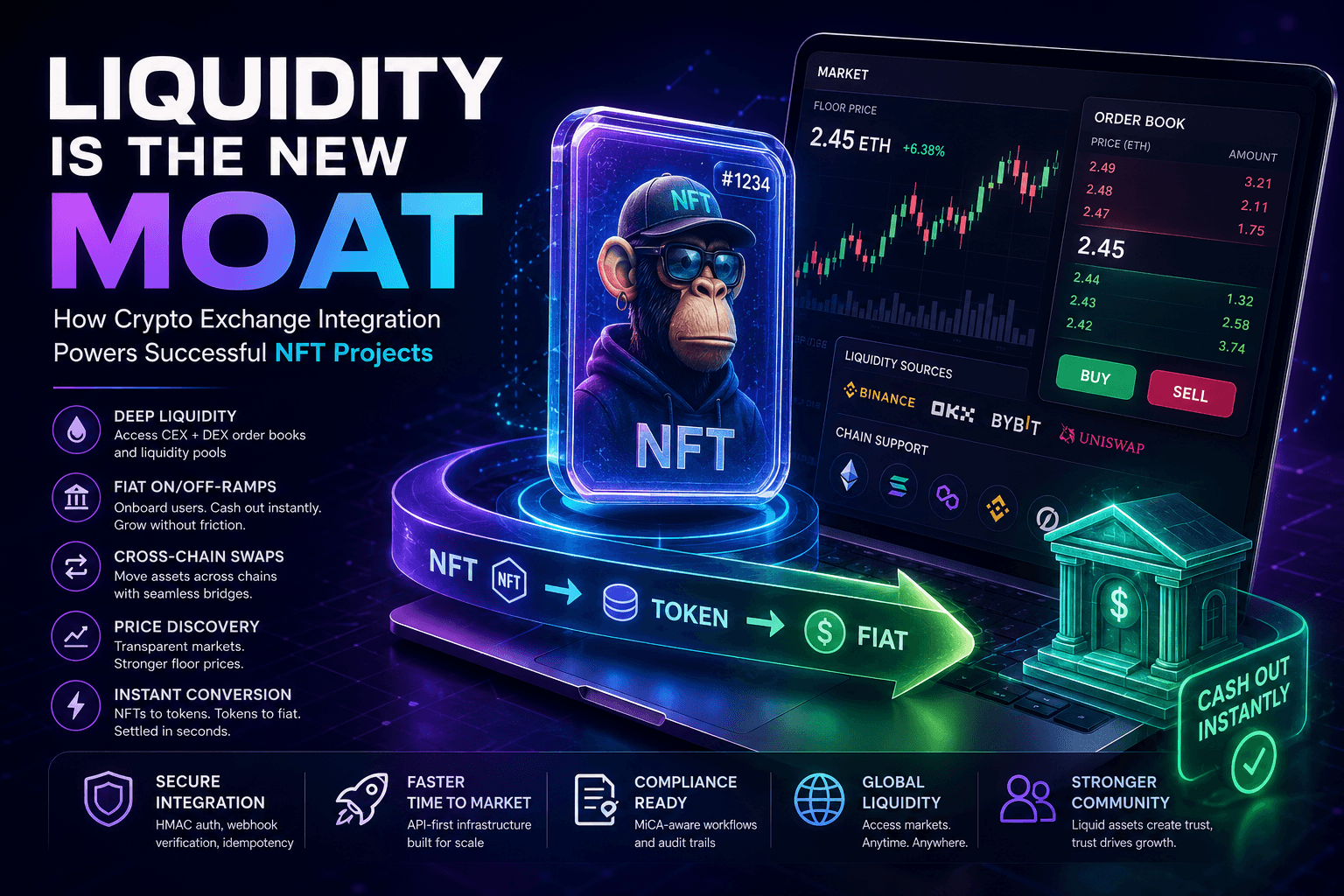
NFT projects no longer succeed by minting art and hoping for community traction. The real bottleneck? Liquidity, fiat on/off-ramps, and seamless trading infrastructure. Projects that ignore crypto exchanges risk dying as "zombie collections" — minted but unmoved, owned but untraded. Integrating exchange functionality isn't optional anymore. It's the difference between a static digital collectible and a liquid asset class.
This guide breaks down why crypto exchanges matter for NFT projects, what integration patterns work at scale, and which limitations can occur.
Table of Contents
- The Liquidity Problem
- Integration Models: How NFT Projects Actually Connect to Exchanges
- 1. Embedded Exchange Widgets
- 2. API-First Integration
- 3. Marketplace-as-Exchange Hybrids
- Practical examples
- Architecture: What Production-Grade Integrations Require
- Possible Limitations
- Liquidity Is the New Moat for NFT Projects
The Liquidity Problem
Most NFT projects face the same fate: initial hype, then stagnation. Why? Because ownership doesn't equal tradability. If someone buys an NFT but can't easily sell it, convert it to fiat, or swap it for another asset, the collection loses value perception.
Here's what happens without exchange integration:
|
Problem |
Impact on NFT Project |
|
No secondary market liquidity |
Holders can't exit, floor price collapses |
|
No fiat on-ramp |
Non-crypto users blocked from buying |
|
No cross-chain swaps |
Assets locked on single blockchain |
|
No price discovery |
Valuation becomes opaque, trust erodes |
|
No instant conversion |
Sellers wait days for fiat settlement |
Crypto exchanges solve this by providing liquidity pools, order books, and conversion rails. When your NFT project integrates exchange functionality, holders gain confidence that their assets are liquid — and liquidity attracts more buyers.
The infrastructure layer that makes this possible is the crypto exchange API, which connects NFT marketplaces to liquidity sources across CEXes and DEXes without requiring custom bridge integrations.
Integration Models: How NFT Projects Actually Connect to Exchanges
Not all integrations work the same. NFT projects can connect to crypto exchanges through embedded widgets, API-based infrastructure, or fully integrated marketplace-exchange hybrids, depending on their liquidity, compliance, and user experience requirements. Three models dominate the industry:
1. Embedded Exchange Widgets
Projects embed exchange widgets directly into their marketplace. Users swap NFTs for tokens, convert tokens to fiat, or bridge assets across chains without leaving the platform.
Best for: Marketplaces wanting full UX control without building infrastructure.
2. API-First Integration
Backend calls handle NFT-to-token swaps, token-to-fiat conversions, and cross-chain bridges. The exchange logic runs server-side, with webhooks confirming transactions.
Best for: Enterprise platforms needing custom flows, audit trails, and compliance hooks.
3. Marketplace-as-Exchange Hybrids
Some platforms (like Blur or OpenSea Pro) built exchange functionality natively. Orders route to centralized liquidity, slippage is minimized, and settlements happen instantly.
Best for: High-volume marketplaces with engineering resources.
What matters across all models: the integration must handle invoice creation, blockchain monitoring, confirmation verification, and asynchronous callbacks. When APIs manage this lifecycle, they enable faster crypto transaction flows for Web3 users who expect instant settlement without manual wallet approvals.
Practical examples
|
Use Case |
Business Value |
|
NFT marketplace with instant sell |
Holders convert NFTs to fiat/stablecoin in one click, reducing friction |
|
Gaming NFTs with token swaps |
Players swap in-game NFTs for utility tokens without leaving the game |
|
Membership NFTs with redemption |
Members exchange NFTs for physical goods, fiat refunds, or token airdrops |
|
Fractionalized NFT platforms |
Investors trade NFT shares on exchange order books with real liquidity |
|
Cross-chain NFT bridges |
Assets move between Ethereum, Solana, Polygon with instant token conversion |
Enterprise clients also gain flexibility: custom fee structures, referral profit models, and the ability to offer multiple payout options (fiat, stablecoin, or native token).
Architecture: What Production-Grade Integrations Require
Production-grade integrations demand a server-side approach. Never expose API credentials or handle raw blockchain transactions in the frontend. The backend must handle five core responsibilities:
Secure authentication. Every request requires X-API-KEY plus X-PAY-SIGNATURE (HMAC-SHA512) to maintain data integrity.
Sandbox testing. Simulate successful swaps, timeouts, and underpayments before deploying with real capital.
Webhook verification. Signature checks confirm transactions originated from the legitimate provider, not attackers.
Idempotency enforcement. Correlation IDs prevent duplicate NFT transfers from the same webhook event.
Edge case testing. Validate behavior under chain reorganizations, gas spikes, and provider rate limiting.
Without these controls, the integration fractures under real-world stress.
Possible Limitations
Even robust integrations face hard limits:
Liquidity gaps for rare NFTs. Aggregation can't create buyers where none exist. Ultra-rare NFTs still suffer massive slippage or fail to swap.
Cross-chain bridge fragility. Bridges remain the weakest point. Even audited ones have lost hundreds of millions. You can mitigate risk but not eliminate the possibility of assets locking indefinitely.
Regulatory gray zones. MiCA and SEC treat NFTs inconsistently. Some NFT-token conversions may qualify as securities, triggering registration requirements. APIs can't auto-determine this.
Fiat on-ramp dependency. APIs don't control banking partners. If your fiat provider freezes accounts, the integration breaks.
Gas fee volatility. APIs can't stabilize network gas prices. During congestion, costs may exceed the NFT's value, making trades unfeasible.
Sandbox-to-production gaps. Sandboxes rarely reproduce edge cases like chain reorganizations or rate limiting. Production bugs often surface only with real capital at risk.
These aren't engineering problems. They're structural constraints of crypto infrastructure itself.
Liquidity Is the New Moat for NFT Projects
NFT technology is mature; the bottleneck isn't minting or metadata — it's liquidity. Projects that integrate exchange functionality gain a competitive moat: holders trust their assets are tradable, buyers enter through fiat on-ramps, and volume sustains floor prices. Winning NFT projects will combine deep, diversified liquidity through CEX + DEX aggregation, robust webhook verification and idempotency controls, MiCA-compliant compliance workflows for NFT-token swaps, and instant fiat/stablecoin conversion options. The real challenge is execution speed — building the integration faster than competitors while maintaining regulatory compliance and technical reliability.