


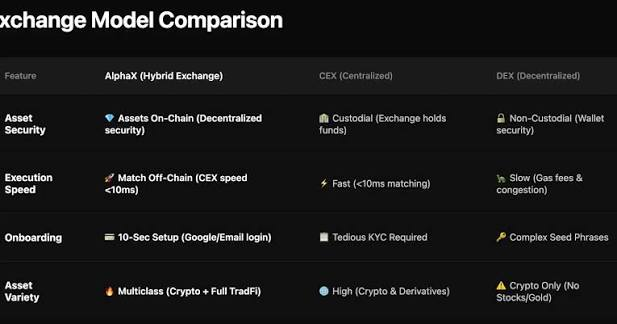
What if choosing to list or trade on an exchange inherently meant choosing between the lesser of two evils? That’s been the gripe of nearly any crypto trader over the past decade or so. There are so many setbacks on each, yet you have to choose either a centralized or a decentralized exchange. One of the primary wishes everyone has had has been the speed, convenience, and liquidity of a centralized exchange with the control of a decentralized one.
CEXs provide efficiency; however, when users deposit their assets on one, those funds can’t remain a mere afterthought. Ownership may still belong in the economic sense, but access to the assets depends on the exchange’s systems, policies, and ability to process withdrawals. This can work smoothly for years, until something goes wrong – such as a security breach, withdrawal freezes, insolvency, or poor platform management. That said, removing the intermediary doesn’t remove every problem. Users deal with congestion right when they need their crypto the most.
Table of Contents
New hybrid crypto exchanges have answered the bell to tackle particular issues, addressing popular user frustrations. What Evedex.com is doing now is attempting to combine many of the gambits of CEXs and DEXs. Developers are building new infrastructure, while businesses reap major practical advantages.
Key Hybrid Exchange Technologies
All sorts of solutions have been popping up to soothe pain points where they are most prioritized. The olden days of offering a purely centralized or decentralized exchange are now behind us. Businesses and users are starting to expect to get some type of hybrid. Many use centralized infrastructure to operate transactions like clockwork. Other platforms delight users with the peace of mind of transparency, self-custody, and verifiable settlement, who consider these qualities essential.
Off-Chain Infrastructure
A lot of platforms are facilitating rapid execution for conventional businesses and users, like:
- High-frequency trading
- Micropayments with low transaction costs
- Cross-border transfers
- Stablecoin payments
- DEX swaps
- Layer-2 transactions
This division allows the platform to maintain a responsive trading experience without making complete reliance on centralized custody necessary. For active traders, this is also quite a huge deal, since markets can shift and flip in a hurry, and waiting for blockchain confirmations can interfere majorly with that. It puts a hamper on business. Then, keeping all your funds under a single exchange’s control is yet another concern in its own right.
Enhanced Liquidity
This is a particularly sore consideration for projects that have traditionally had to commit to a DEX over a CEX. There, in order to achieve secure price stability for a token, a developer would have to set aside a couple hundred thousand dollars to avoid price volatility. This eats up the entire would-be savings from choosing to avoid a CEX in the first place. Without the upfront capital, a shallow liquidity pool leaves a newly launched token highly vulnerable to severe price depreciation and volatility if early whales or investors distribute their holdings.
To resolve these systemic liquidity shortages, hybrid infrastructure platforms are consolidating diverse capital channels into a unified network, aggregating such sources as:
- Liquidity pools
- Market-making infrastructure
- Institutional liquidity partnerships
- Cross-chain routing: enabling users to seamlessly interact with assets across isolated networks using native Web3 wallet connections
The primary objective of this architecture is to mitigate price slippage, ensuring the order books can absorb large-volume trades from high-net-worth participants without destabilizing asset prices.
Making Self-Custody More Practical
This is one of the most popular decentralized technologies. Platforms like Uphold Vault offer a multi-signature self-custody setup while you hold two keys, allowing instant trading access while retaining absolute ownership in a familiar-looking trading environment.
Users can also get different wallet arrangements for different purposes:
- Hot wallets: provide convenient access for frequent trading
- Cold wallets: can be used for more secure storage to keep private keys under the user’s control.
Features like wallet-based login, decentralized settlement, and on-chain verification are moving from being mere specialized options toward becoming expected parts of the trading experience.
Greater Transparency
Traders may be leery of relying solely on the private internal ledger maintained by a centralized exchange. In a hybrid exchange model, selected records, such as settlement transactions, proof of reserves, or asset movements, can be recorded on-chain, creating an auditable and independently verifiable trail.
Smart contracts are designed to automatically execute predefined rules, including settlement or collateral management logic, given that the requisite conditions are met. This automation can:
- Reduce the manual processing burden
- Enhance operational consistency
- Mitigate particular operational risks
Nevertheless, this does noes not eliminate the need for governance, security controls, and compliance oversight.
Compliance for Institutional Participants
Nowadays, central banks, private financial institutions, and behemoth companies are producing their own digital coins thanks to the ease of technology for cheap, borderless transactions. Platforms want their involvement and funding too, and for that reason, complying with the law as thoroughly as possible goes a long way in securing their cooperation and interest. In the past, compliance procedures have been bolted onto exchanges after the fact.
Now, a number of hybrid exchanges are being built from a compliance perspective first. Official World Cup partner ADI PredictStreet has benefitted massively from launching this Spring with such an approach, securing numerous state partners as well while facilitating crypto and fiat prediction betting.
This, of course, includes measures like KYC, AML, and anti-terrorism. One of the reasons this is a big boon is many institutions cannot simply use exchanges without considering regulatory obligations. Regulatory requirements also differ between jurisdictions, so businesses need infrastructure that can adapt as those requirements change.
Why Hybrid Exchanges Matter for Businesses
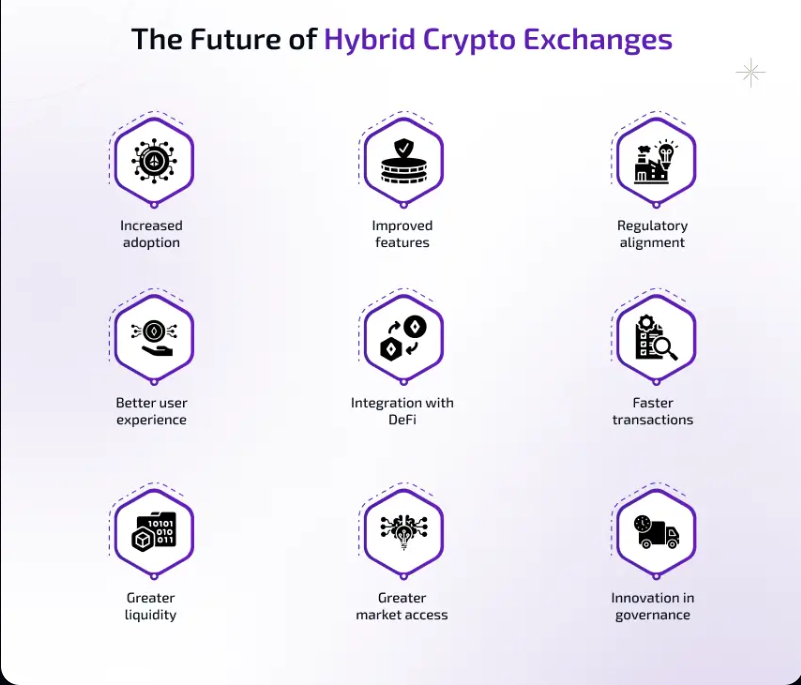
The significance of exchange technology is becoming ever more relevant to businesses. The architecture creates opportunities to target specific markets, attract institutional participants, support tokenized assets, and build extra revenue streams around the core exchange.
New Opportunities for Exchange Startups
A new exchange doesn’t necessarily need to compete directly with the largest crypto platforms on every front. Loopring is an example of a protocol designed around non-custodial, order-book-based trading on Ethereum, using zero-knowledge technology to improve scalability while keeping assets under users’ control.
A lot of traditional businesses today recognize the potential that crypto offers for raising startup capital. For that reason, many of them launch their own token, which enjoys utility since it’s based on a real business.
Institutional and Enterprise Adoption
JPMorgan, one of the leading banks in the US, has launched a platform through Kinexys, which is used to support blockchain-based financial infrastructure and tokenization. Schroders recently received approval for a tokenized share class of a money-market fund using Kinexys technology and blockchain-based smart-contract transactions. This is yet another example of how businesses increasingly need systems capable of connecting traditional finance requirements with blockchain-based settlement and asset ownership.
Countless central bank digital currencies exist, issued by the central reserves themselves, such as the Sand Dollar in the Bahamas, Jamaican JAM-DEX, and the eNaira. These operate alongside privately issued stablecoins pegged to national currencies.
Multiple Revenue Streams
Various hybrid exchange models also give businesses far more opportunities to generate revenue above simply charging a fee every time someone places a trade. Additional services built around the core trading platform often include:
- Staking
- Lending
- Yield products
- Liquidity services
- Premium trading tools
- Subscription-based features
One innovative resource is Bitget. It operates as a self-custodial platform supporting:
- Trading
- Earning
- On-chain apps
- Centralized exchange services on the wider ecosystem
- Trading real-world assets like gold,, and oil
- Stock trading
So there are multiple points at which users can interact with digital assets. The takeaway here is hybridization can support a broader product system.
Challenges for Hybrid Exchanges
Incorporating multiple blockchains, smart contracts, liquidity, and off-chain trading has a lot of pitfalls, and one weakness or incompatibility in a single layer can affect the performance of the wider platform. So it requires a huge level of expertise. Businesses also need scalable backend infrastructure from the beginning rather than trying to rebuild the platform once trading volumes have already increased.
Unfortunately, the more points of interaction a platform has, the greater its potential attack surface and the more vulnerabilities it may introduce. Smart contracts can automate settlement processes, but their logic must be designed and implemented securely. Building these complex systems to operate across multiple jurisdictions is another significant challenge, as legal and regulatory requirements vary widely. That is why compliance-ready infrastructure is now essential.
Operating cross-chain is also difficult to maintain since networks have their own infrastructure, transaction processes, and requirements. Businesses have to determine which networks actually provide enough trading demand and liquidity to actually justify the extra elbow grease.
Which Hybrid Exchanges Matter for Your Business?
The answer to this question is not completely straightforward for every organization or protocol. It depends on the particular platform, the market you serve, and your user base’s needs. The more traditional, mainstream, and formal your audience, the more you’re going to tend to need compliance-heavy features, so as to render reporting easy and ensure regulations are automatically fulfilled. This is a benefit no matter who you’re dealing with. This is an even bigger deal the more internationally you operate since regulations differ so dramatically country-to-country.
If your project lacks liquidity, consider accessing liquidity across multiple chains. Focus on the networks your target users are most likely to use. If your audience is younger and prioritizes speed and low transaction costs, Solana may be worth supporting. However, add cross-chain capabilities only when the expected benefits justify the additional technical and operational complexity. There is no one-size-fits-all hybrid platform: integrations require ongoing monitoring and maintenance, so prioritize the features that are most relevant to your users.