
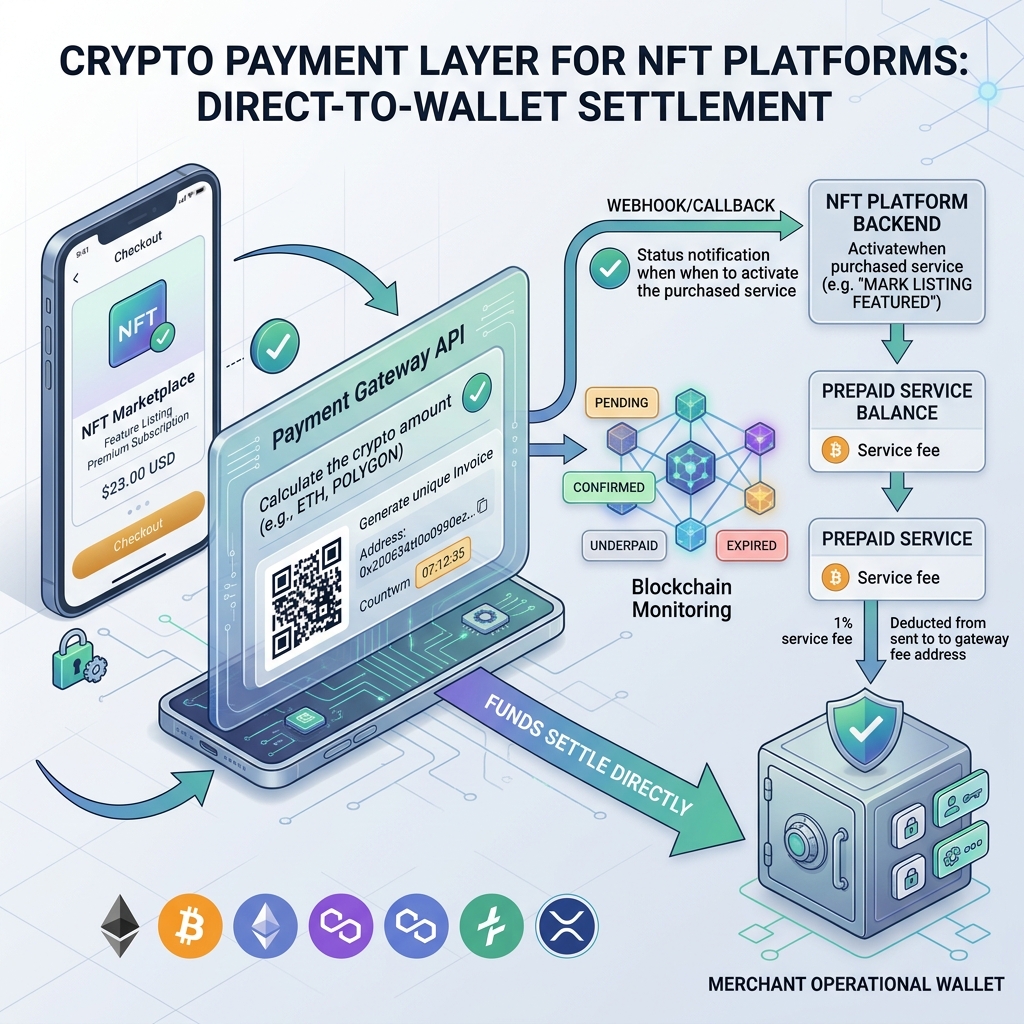
NFT platforms may be native to Web3, yet their commercial checkout still needs the discipline of ordinary payment operations. A service such as Bcon Global can create a fiat-denominated invoice, calculate the required crypto amount, monitor the blockchain, and notify the platform when payment is confirmed. The merchant connects only a public wallet address, so settlement goes directly to a wallet the business controls rather than to a gateway balance.
Why NFT Businesses Need a Separate Payment Layer
An NFT marketplace can have several payment moments beyond the transfer of a token itself. It may charge for featured listings, creator tools, subscriptions, ticketed access, or professional services. Building blockchain monitoring independently for every charge creates operational work: the platform must generate unique invoices, identify underpayments, watch confirmation states, and connect each transaction to the correct order. A payment layer standardizes this flow while the marketplace keeps its own product logic.
Table of Contents
The distinction between an NFT transaction and a commercial invoice should remain clear. A crypto gateway does not replace the smart contract that transfers an NFT. It handles the checkout for the goods or services defined by the merchant, records the expected amount and payment address, and returns a status that the application can use.
How Direct-to-Wallet Checkout Works
The core flow is short and auditable:
- The platform sends the order amount and fiat currency to the gateway.
- The gateway creates an invoice with the exact crypto amount and payment details.
- The buyer pays from a compatible wallet on the selected network.
- Blockchain monitoring detects the transaction and follows its confirmation status.
- A callback or status request allows the marketplace to activate the purchased service.
This structure separates payment verification from asset custody. Bcon Global states that it does not request private keys and does not hold merchant funds. That is especially useful for a Web3 business whose treasury policy requires payments to arrive in a designated operational wallet.
Design the Checkout Around Network Clarity
Wallet users can still make mistakes if the checkout does not show the chosen network prominently. Display the asset, network, exact amount, destination address, and invoice timer together. Add a QR code for mobile wallets, but keep the text address available for verification. The confirmation screen should explain that blockchain transactions cannot be reversed and that sending an unsupported asset or using the wrong network may prevent automatic matching.
Operational Controls Before Launch
A marketplace should define what happens at every status, not only after a successful payment. The launch checklist should include:
- a pending state that does not deliver the paid feature prematurely;
- rules for expired, late, or insufficient payments;
- idempotent webhook processing so repeated callbacks do not create duplicate access;
- a support view containing the order ID, invoice ID, network, transaction hash, and timestamps;
- separate wallets or accounting labels when treasury teams need clearer reconciliation.
Use a test environment or low-value test orders before enabling checkout for all users. Confirm that a valid payment changes the order exactly once, an expired invoice remains closed, and the support team can trace a payment from the platform record to a public block explorer.
Security and Treasury Considerations
Direct settlement reduces gateway custody, but the merchant remains responsible for its wallet. Use a business-controlled address, document who can update it, and protect administrative accounts with strong authentication. For larger balances, a multisignature or hardware-wallet process may be appropriate. Never store seed phrases or private keys in the marketplace application, a plugin, or a customer-support tool.
The commercial model also needs review. Bcon Global lists a 1% service fee funded through a prepaid service balance, while the transaction principal goes to the merchant wallet. Finance teams should understand that separation and monitor both payment receipts and the service balance used to keep the gateway active.
A Practical Rollout Sequence
Start with one paid feature, one or two networks, and a limited user group. Measure successful payments, expirations, support contacts, and time to confirmation. Then improve the interface before adding more assets or checkout locations. This controlled rollout gives product, support, and finance teams a shared picture of how crypto checkout behaves in real conditions.
For an NFT business, the strongest implementation is not the one with the most coins on day one. It is the one that gives buyers unambiguous instructions, gives the application dependable payment states, and gives the merchant direct control over the funds received.