

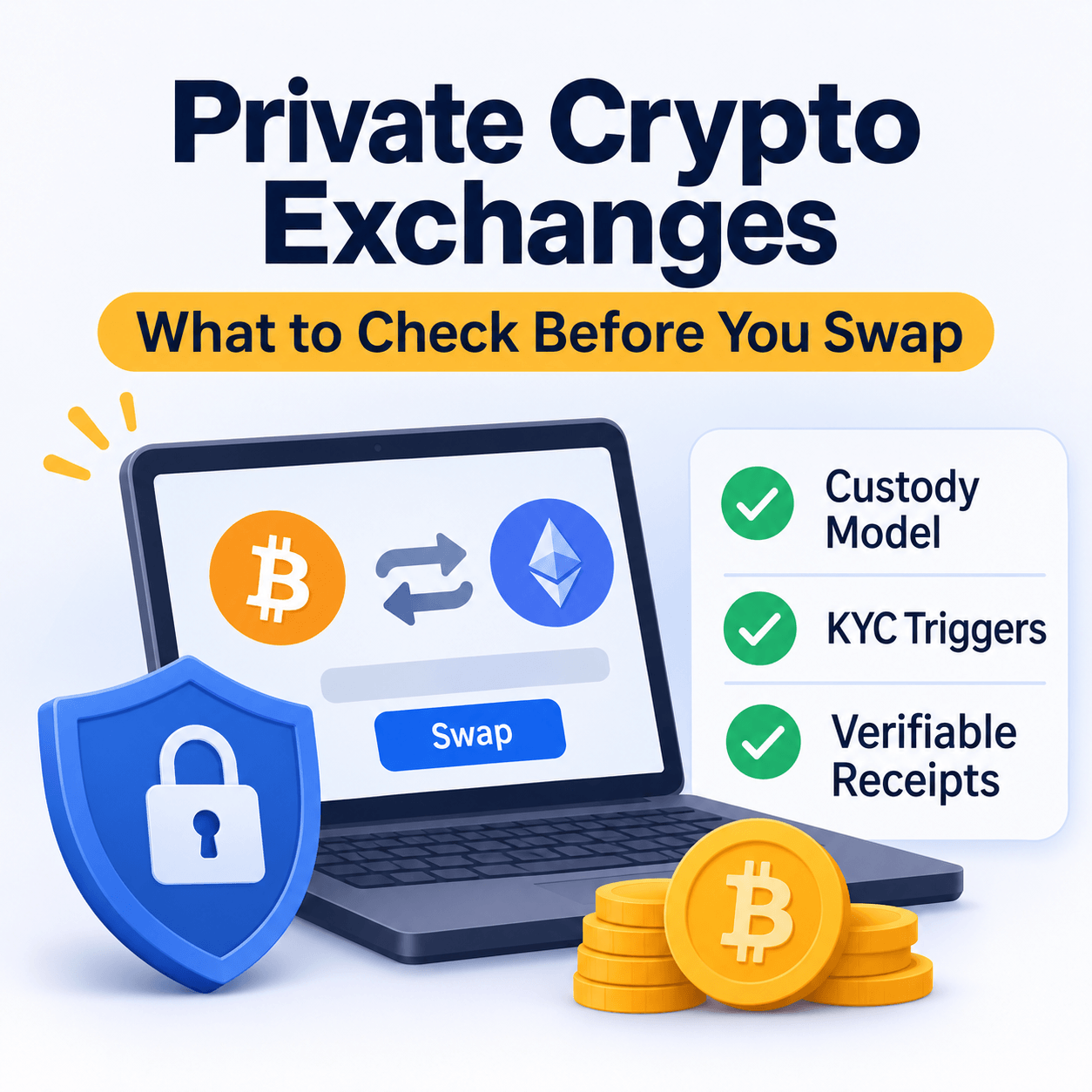
Private crypto exchanges look alike from the outside: no sign-up, a swap form, a payout address. What separates them is mechanics. Three questions decide most of the difference: who holds the coins while an order is processed, which events push a user into identity checks, and whether the service hands over proof of the trade that can be checked without trusting its website. A private crypto exchange that settles from its own reserves, publishes its verification policy and signs every receipt carries a very different risk profile from one that simply skips registration, even when both use the same “no account needed” headline.
What a private crypto exchange actually does
In most cases the service is an instant swap desk. The user picks a pair, sends coins to a one-time deposit address and receives a different asset at an address of their choice. No balance is kept, and no profile links one order to the next. Services such as 0trace, a private crypto exchange that pays out from its own liquidity and issues PGP-signed guarantees and receipts for each order, are built around this model.
The label covers more ground than it suggests, though. Behind an identical interface, one operator may hold its own reserves while another routes every order to a large centralized exchange and passes the result back. The private crypto exchange tag does not reveal which design sits underneath, so marketing copy is a weak basis for comparison. A more useful approach is to look at the plumbing: custody, KYC triggers and receipts.
Custody during the swap: where private exchanges really differ
Services that offer a private exchange of crypto without accounts are often called non-custodial. Strictly speaking, most of them are not. Between the moment a deposit confirms and the moment the payout leaves, someone holds the funds. The real questions are who, and for how long.
Three designs dominate the market. In a brokered swap, the front-end forwards the deposit to a partner exchange and buys the target asset there. The front-end then inherits the partner’s compliance rules: if the upstream desk flags the coins, the order can stall for days, and the swap service may have no power to release it.
In an own-liquidity model, the operator pays out from reserves it controls and rebalances later on its own schedule. Exposure shrinks to the deposit window, usually a few minutes to half an hour, but it rests on one operator’s solvency and conduct. Atomic swaps and DEX routes remove the middleman through hash time-locked or smart contracts. The price is a shorter list of pairs, higher on-chain fees and a transaction trail that stays linkable.
For an analyst, the length and control of the custody window matter more than the word “non-custodial” on a landing page. A 20-minute window with one accountable party is not the same exposure as a 20-minute window that can turn into a two-week hold at a third party.
KYC triggers: what actually prompts a check
On a typical no-KYC crypto exchange, “no KYC” is a default rather than a promise. Many services describe themselves that way while keeping the right to request documents once certain conditions are met. Those conditions are the real policy, and the most common ones look like this:
- Amount thresholds: single orders or cumulative volume above a set limit, often close to the USD/EUR 1,000 level the FATF uses for its Travel Rule.
- Risk scores on incoming coins: blockchain analytics tools rate deposits by their history, and a high score can freeze an order pending review.
- Upstream partner holds: brokered services pass on whatever their liquidity provider decides, regardless of their own wording.
- Jurisdiction signals: IP ranges from sanctioned regions or payout addresses tied to listed entities.
- Behavioral patterns: split deposits, rapid repeat orders or amounts that differ sharply from the quote.
Regulation explains why these triggers exist. In the EU, the Transfer of Funds Regulation has applied since 30 December 2024 to crypto transfers between providers, with no minimum amount, and it also sets checks for transfers to and from self-hosted wallets. A service operating inside that framework cannot offer blanket anonymity, whatever its homepage says.
Other operators take the opposite line and state publicly that they never request identity or AML documents under any circumstances. Either way, the practical test is the same. KYC triggers written down as specific conditions can be weighed before a deposit, while a vague “at our discretion” clause cannot.
Verifiable receipts: proof without an account
When there is no account, there is no history page. The user’s record of a trade is whatever the service hands over, and a screenshot of an order page proves very little: it can be edited, and the page may be gone within days. Privacy-focused exchanges that wipe order data after a fixed period, often 24 to 72 hours, make that gap even wider.
Signed documents close it. The stronger setups issue two of them: a guarantee before payment that fixes the deposit address, rate and expected amount, and a receipt after payout that confirms what was sent. Both carry the operator’s PGP signature, so any OpenPGP tool can check them offline. A sensible routine for verifiable receipts runs like this:
- Download the operator’s public key and compare its fingerprint with a copy published somewhere the operator does not fully control, such as a long-running forum thread or an independent listing.
- Save the signed guarantee before sending funds and confirm that the deposit address inside it matches the one on screen.
- Run gpg --verify on the saved file, treating any web-based checker as a second opinion rather than the only one.
- After payout, verify the receipt and match its transaction hash against a block explorer.
- Store both files offline, since the service will not keep a copy for long.
The weak point is the key itself. A signature proves something only if the fingerprint was checked against an independent source. Skip that step, and a cloned site could sign its own fake guarantees just as easily.
Private crypto exchanges compared side by side
The table sets the main designs against the three variables above, plus the trade-off each one asks the user to accept.
|
Model |
Who holds funds mid-swap |
What usually triggers KYC |
Proof the user keeps |
Main trade-off |
|
Custodial exchange account |
The exchange, for as long as the balance sits there |
Account opening |
Full account history and statements |
Identity tied to every trade |
|
Brokered instant swap |
Partner exchange while the order is processed |
Partner risk flags and amount limits |
Order ID page, sometimes an email |
Holds decided upstream, outside the front-end’s control |
|
Own-liquidity instant exchange |
The operator, for the deposit window only |
Whatever the published policy states; some list none |
Signed guarantee and receipt, where offered |
Trust concentrated in one operator’s reserves |
|
P2P marketplace |
Escrow or the counterparty |
Varies by trader and platform |
Escrow record and chat log |
Slower settlement and counterparty risk |
|
Atomic swap or DEX route |
No one; contract logic settles the trade |
None at protocol level; some front-ends screen wallets |
On-chain transactions |
Fewer pairs, higher fees, public trail |
No row wins on every column. Own-liquidity desks shorten the custody window but concentrate trust. Atomic swaps remove custody yet leave a permanent public record and limit pair choice. Brokered swaps are often the cheapest to run and the hardest to predict, because the rules that matter sit with someone else.
Comparing private crypto exchanges on custody, KYC and receipts
The comparison comes down to three checks that can be done before the first deposit. First, find out whether the service settles from its own reserves or forwards deposits to a partner, because that decides whose compliance rules apply mid-swap. Second, read the terms for named KYC triggers: a list of conditions is a policy, a discretionary clause is not. Third, confirm that a PGP-signed guarantee before payment and a signed receipt after payout are available, and that the signing key matches a fingerprint published outside the operator’s own site.
How much each check weighs depends on the use case. For a single large swap, custody and upstream holds are the main risk, so own-liquidity desks or atomic routes deserve priority. For frequent smaller swaps, data retention and receipts matter more, since the user alone keeps the evidence. A private crypto exchange that documents all three points in public can be judged on facts before any funds move; one that documents none can only be judged on reputation.