Hot drops quickly attract copycats. One NFT scam can empty your collection in seconds, and the signing screen usually appears completely normal. The good news: most NFT scams follow a few well-known patterns. As soon as you know these patterns, you'll be able to spot potential trouble before you click. This article looks at the main tricks and includes a simple routine to run before every launch.
Why NFT Scams Still Work in 2026
Scammers follow the crowd. Large-scale launches generate a lot of excitement, involve strict deadlines, and see thousands of people clicking quickly. This combination is ideal for fraud.
Table of Contents
Here are the numbers, with context. In 2025, losses from wallet-draining phishing decreased to about $83.85 million among 106,106 affected wallets, down from nearly $494 million the year before. The data covers all signature-phishing cases on EVM chains, including NFT ones. The drainer ecosystem is still active, and the losses reached their peak in the third quarter, when Ethereum experienced its strongest rally that year. To put it plainly, a calm year does not mean that a sale is safe. When the market becomes more active, so does the risk.
Fake Mint Websites and Clones of Famous Collections
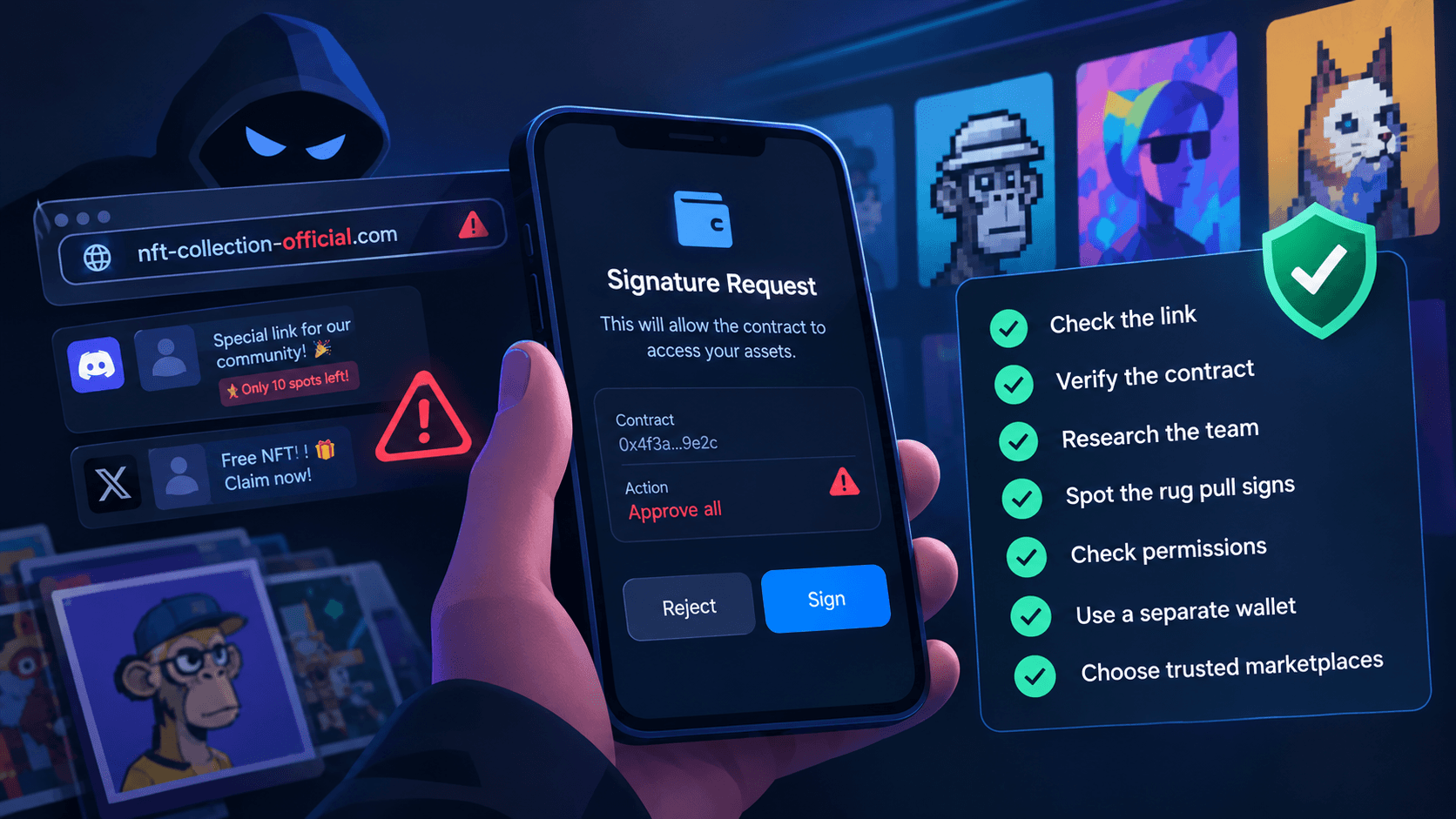
The most common NFT scam is a fake mint site. The fraudsters copy the design of the project, purchase a domain that is similar in appearance, and then promote it through ads or replies to real posts. The page appears correct, but the URL differs by a single letter.
Watch for these warning signs:
- A domain with extra words like "official," "claim," or "live".
- A countdown timer that resets every time you reload.
- A "surprise" collection with no earlier announcements.
- Art or names that copy a famous project with a tiny twist.
Clones function in the same manner: a fake NFT collection takes advantage of a well-known name to appear trustworthy. Therefore, you should first find the actual link on the project's verified X account and then check it against the project's listing on an NFT drop calendar, where verified projects carry a tag.
How NFT Fraud Hides Behind Wallet Drainers
A wallet drainer is software that is placed on a fake website. It requests a signature and then siphons off your funds. You never have to send anything manually since the signature does all the work.
That is why malicious transaction signatures are so dangerous: a popup might display "Verify profile" or "Claim reward". However, the request behind it could grant a stranger full access to your tokens. Permit-style requests are particularly deceitful since they appear to be ordinary login steps, and that is exactly how a clean-looking page pulls off an NFT scam.
The data illustrates the extent of damage that a single signature can cause. The biggest individual phishing incident in 2025, which amounted to a loss of $6.5 million in September, was the result of a malicious Permit signature. Permit-based attacks also made up 38% of cases with losses over $1 million. That incident wasn't an NFT drop, but the same type of request can appear on a fake mint page.
Follow these steps on every popup:
- Take a moment to read the request. Do not click through.
- Find out the name of the contract and the name of the action it refers to.
- Search for expressions such as "approve all" or "permit".
- Reject anything that doesn't match a simple purchase.
- If your tool has a transaction preview, use it.
Check your wallet permissions once a month as well and cancel any approvals that you don't need anymore. Old approvals are open doors, so close them.
Spot Every NFT Scam Signal on Discord and X
Discord phishing is still widespread. Hackers gain control of an admin login and then put a "special link" in the announcements. In other cases, they send direct messages and pretend to be from support staff. Similarly, fake replies to real posts on X lead you to cloned sites.
Fake airdrops are another common scam. A token appears suddenly with no explanation, and a website asks you to "claim" it. Claiming involves agreeing to a harmful request. At the same time, urgent offers such as "only 10 spots left" encourage you to bypass your normal checks. Since urgency is used in almost every NFT scam, take your time when you receive a message asking you to act quickly.
Keep these rules in mind:
- Real teams almost never DM you first.
- Real support never asks for your seed phrase.
- Free surprise items are bait.
- Disable DMs from server members.
Seed phrase protection comes down to one habit: never type it into a website, a chat conversation, or a form. You should keep it offline, on paper or on metal, and never take a photo of it.
Unverified Minting Websites That Collect Your Data
Some NFT scam websites ignore your assets and go after your data instead. An unverified page can record your IP address, wallet address, and browser fingerprint as soon as it has loaded. This data can later be used to carry out targeted phishing or to associate your identity with your holdings.
The basic rule is this: when you're on a page that you don't know well, or that hasn't been verified, don't give out any personal details. Most genuine mints don't require your phone number or ID, and no legitimate one asks for your email password.
You can also reduce your exposure. Some collectors hide their actual IP address when looking at projects they don't know, usually by using cheap proxies from Proxy-Seller or another reputable service. In this way, a doubtful page will see the proxy address rather than your home connection. However, a proxy only provides one level of protection. You should also use a separate browser profile, block trackers, and keep your main collection separate from links you haven't tested.
Your Pre-Mint Checklist Against Any NFT Scam
Before you mint each item, go through these steps. They take about five minutes and stop most NFT scam attempts.
- Check the official link by referring to the project's verified X account and website, and then compare it letter by letter.
- Verify the smart contract by opening it on a block explorer and checking that the code has been verified and that the address matches the one announced by the team.
- Research the team by checking their public profiles, looking at their previous work, and seeing if they have an active community. An anonymous team isn't necessarily a bad sign, but it should still be treated with care.
- Look for the rug pull pattern. Grand promises, no clear plan of action, and then a sudden silence following the sale are all typical signs of a rug pull.
- Check the wallet permissions and read exactly what the site requests before you agree to anything.
- Use a separate wallet. Mint from one that holds only the amount you plan to spend. Store your more valuable items in a hardware wallet.
- Choose established marketplaces. The directory of marketplaces is a useful source for finding out which platforms are well-established.
If anything still seems wrong, you should ask in the official channels. If you're unsure about a contract, discuss it with other collectors or look at it again the following day. Missing a single launch costs a lot less than losing your entire collection.
Wrap-Up
Safety is a habit rather than something you have to do once. Each NFT scam uses the same three factors: speed, hype, and a hurried signature. Make sure you check the link, read the prompt, verify the contract, and set a limit on how much a single profile can lose. Your routine will need to be updated as new tricks emerge, so continue to learn and keep adjusting your checklist. The more carefully you make purchases, the easier each subsequent one will be, and eventually you'll spot warning signs almost without having to think about it.